
A client came to us last year with 140 published blog posts and almost nothing to show for it. Traffic was flat. Rankings moved around without any clear pattern. And when we asked ChatGPT and Perplexity questions in their space, their site never came up — competitors with a fraction of the content did.
The problem wasn’t a lack of effort. It was that 140 posts covered dozens of loosely related topics instead of building depth in one. That’s the difference between having a blog and having topical authority — and it’s the difference that increasingly decides whether a business shows up in google, in AI overviews, or in a ChatGPT answer at all.
This isn’t a call to publish more. It’s a way to think about what to publish, what to skip, and how the pieces should connect.
What Topical Authority Actually Means
Topical authority is how confidently search engines and AI systems associate a website with genuine expertise on a specific subject. It’s built by covering a topic in real depth — not just the obvious entry-level questions, but the follow-up questions, the edge cases, and the decisions a reader actually has to make.
It’s often confused with domain authority, but the two measure different things. Domain authority is a general strength score based mostly on backlinks — it says something about the whole site. Topical authority is narrower and more useful: It asks whether this site is a credible source on this subject, regardless of how strong the domain is overall. A small, focused site can out-rank a much bigger one on its core topic if its coverage is more complete and more clearly connected.
That distinction matters because it changes what “authority-building” actually requires. You Don’t need more domain-wide backlinks to build topical authority. You need a body of content on one subject that’s structured so both readers and machines can see how the pieces relate to each other — which is exactly where why most SEO strategies fail before they even launch tends to start: Teams optimize for volume and rankings instead of for coverage and trust.
Why It Matters More, Not Less, in AI Search
There’s a version of this conversation happening right now that assumes topical authority is a google-Era concept on its way out — that AI search runs on different rules entirely. It doesn’t. It runs on a stricter version of the same rule.
When an AI system answers a question, it isn’t scrolling ten blue links and letting a person choose. It’s synthesizing one answer and deciding, source by source, which sites it trusts enough to pull from. That decision leans heavily on how thoroughly a site covers the surrounding subject, not just whether one Page happens to match the query. Industry analysis of AI citation behavior has found that topical relevance can outweigh raw domain strength — a smaller, more focused site can out-cite a much larger publication if its content is more directly aligned with the specific category being asked about.
The stakes are also different. A Page that ranks #7 on google still gets found by someone willing to scroll. A Page that doesn’t make an AI system’s shortlist of trusted sources doesn’t get mentioned at all — there’s no Page two. Consistent, connected topical coverage is what earns a spot on that shortlist in the first place. This is the reasoning behind ethical ai-assisted SEO: The goal isn’t to game AI systems, it’s to give them a legitimately well-organized, well-sourced body of content to draw from.

How Search Engines and AI Systems Actually Recognize Authority
Neither google nor an AI model has a single “authority score” they check. Authority gets inferred from a handful of signals working together, and it’s worth understanding what those are before building a strategy around them.
Depth and breadth of coverage. Does the site address the topic from multiple angles — the basics, the comparisons, the mistakes, the edge cases — or just the one article that happened to target a keyword? A single well-written Page can rank for a while. It rarely holds authority on its own, because it doesn’t demonstrate ongoing command of the subject.
Semantic relationships between pages. Search systems increasingly evaluate how pieces of content relate to each other, not just whether each one is individually well-written. A cluster of interlinked articles that logically build on one another signals expertise in a way that scattered, disconnected posts Don’t — even if the disconnected posts are individually higher quality.
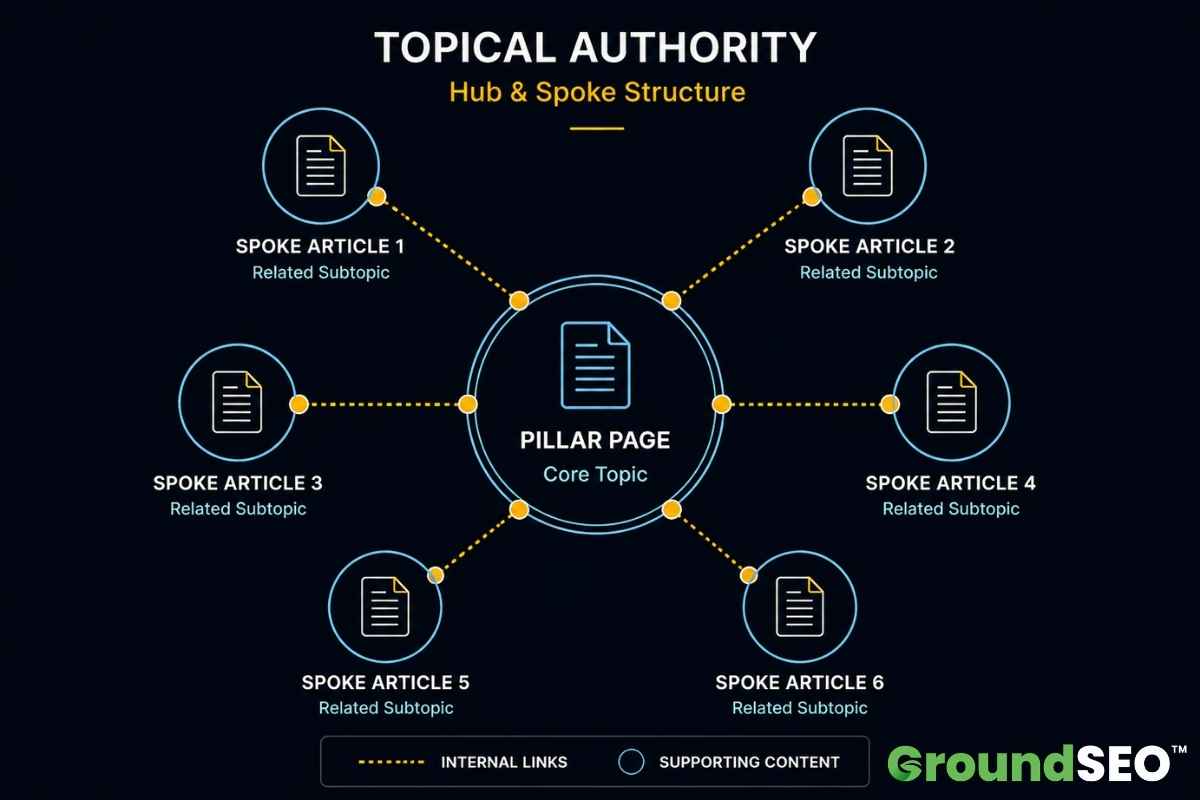
Internal linking structure. This is the mechanism that makes the previous point visible to a crawler or a model. A pillar Page that links out to focused spoke articles, and spoke articles that link back and to each other where relevant, tells the system exactly which pages belong to the same body of expertise. Without that structure, related content just looks like a pile of separate pages that happen to share a website.
Consistency over time. A single burst of content around a topic reads differently than sustained, ongoing coverage. Systems that evaluate trust — e-e-a-t being the clearest framework google has published on this — weight demonstrated, first-hand experience with a subject over content that reads like it was researched once and never revisited. We’ve written more on what that actually looks like in practice in our e-e-a-t guide.
The Mistake That Quietly Undoes Most Attempts at This
The most common approach to “building authority” is publishing more often. It feels productive. It’s also the thing most likely to work against you.
Three unrelated blog posts a week — one on a trending industry topic, one on a loosely connected how-to, one because the content calendar had a Gap — doesn’t build authority on anything. It builds a blog with variety and no center. Search systems can’t identify what the site is about if the content doesn’t consistently point back to the same core subject.
The better approach is narrower than it feels comfortable being at first: Pick the topic your business actually has the standing to own, and build every new piece of content as a deliberate addition to that coverage — not a reaction to whatever seems timely that week. That discipline is uncomfortable because it means saying no to some ideas that would get short-term clicks. It’s also the only version of this that compounds. Our thinking on why chasing surface-level metrics backfires is laid out more fully in why more traffic is the wrong SEO goal.
A Practical Framework for Building Topical Authority
Step 1 — Define the topic by expertise, not keyword volume
Start with what your business can genuinely speak to with depth, not with whatever keyword tool shows the highest search volume. A CRM company has real standing to build authority around sales pipeline management. It has none around general small-business marketing advice, no matter how attractive that traffic looks in a spreadsheet. Authority has to be earned with substance the business can actually back up.
Step 2 — Map real questions before you map keywords
Before building a keyword list, list the actual questions your audience asks — in sales calls, support tickets, onboarding conversations, comment sections. These are usually more specific and more useful than what a keyword tool surfaces first, and they tend to reveal subtopics competitors haven’t bothered covering. Keyword research should refine this list, not replace it.
Step 3 — Build the pillar first, then the spokes
The pillar page is the comprehensive overview of the core topic. The spoke articles are the focused, specific pieces that go deep on one part of it — like this article going deep on one part of a broader SEO authority topic. Publish the pillar early, even in a lighter form, so there’s something for the spokes to connect back to from day one.
Step 4 — Link with intention, not habit
Every spoke should link to the pillar. Spokes that genuinely relate to each other should link to each other too, with anchor text that describes what the linked page actually covers — not generic phrases like “click here” or “learn more.” This is the single most overlooked part of topical authority work, because it takes almost no extra research and gets skipped anyway. Structuring this properly is most of what we mean by content structure as a discipline in its own right.
Step 5 — Go looking for what competitors skip
Read the pages currently ranking or getting cited for your core topic. Note what they explain well, and more importantly, what they gloss over, oversimplify, or leave out entirely. That gap is where a new piece of content earns its place in the cluster — not by restating what’s already well covered, but by closing a real hole in the existing coverage.
Step 6 — Reinforce it off-site, deliberately
On-site structure is the foundation, but it isn’t the whole picture, particularly for AI visibility. Independent analysis of AI citation patterns has found that a meaningful share of citations for broad category questions come from third-party sources — review platforms, industry discussions, comparison sites — rather than a brand’s own domain. Being mentioned consistently across a handful of relevant, credible external platforms reinforces the same topic ownership your on-site cluster is building. This doesn’t mean chasing every mention available; it means showing up, accurately and consistently, on the handful of platforms your actual audience already trusts.

Where Search Intent Fits Into All of This
Coverage without intent alignment is still incomplete. A cluster can technically cover a topic from every Angle and still underperform if each piece answers the wrong version of the question — going deep on technical mechanics when the reader searching that term wants a decision framework, for example, or the reverse.
This is why mapping real audience questions (Step 2) Has to happen before content gets written, not after. Search intent determines not just what to cover, but the form the answer needs to take — a comparison, a step-by-step process, a definition, a framework. Our approach to intent-driven keyword optimization starts from this question before anything Else, because a technically well-linked cluster that answers the wrong intent at every step still won’t hold authority — it’ll just be a well-organized miss.
How Long It Takes, and How to Know It's Working
There’s no honest fixed timeline here, and any article claiming an exact number of weeks is guessing. What’s reasonably consistent across most SEO and GEO analysis is that early movement — a few AI citations, a ranking improvement on a long-tail term — can show up within weeks if a piece fills a real gap. The deeper structural authority, the kind that shows up consistently across a whole topic rather than one lucky page, tends to take several months of sustained, connected coverage to establish.
Rather than watching one keyword, track the pattern across the cluster: are more pages within the topic ranking over time, not just the pillar. Are spoke pages picking up impressions for questions you didn’t explicitly target. Are you starting to see the brand referenced when you check AI tools for questions in your category. None of these are vanity numbers — they’re evidence the cluster is being recognized as a coherent body of expertise, which is the entire point.
Building this kind of structure from scratch, or untangling 140 disconnected posts into something coherent, is exactly the kind of work that benefits from an outside system rather than more content produced in isolation. If you want a second set of eyes on whether your current content actually adds up to topical authority — or just adds up to a lot of blog posts — talk to the groundseo team about your organic growth goals.

FAQ
What's the difference between topical authority and domain authority?
Domain authority is a general strength score for an entire website, based mostly on backlinks. Topical authority is specific to one subject — it reflects how thoroughly and credibly a site covers that particular topic, regardless of the site’s overall size or backlink profile. A small, focused site can have strong topical authority in its niche without high domain authority overall.
Does topical authority still matter now that people use AI tools instead of Google?
It matters more, not less. AI systems synthesize one answer from a small set of sources they trust, rather than presenting ten links for a person to choose from. Thorough, well-connected coverage of a subject is one of the clearest signals that determines whether a site makes that shortlist.
Do I need to publish content constantly to build topical authority?
No — publishing frequency isn’t the signal. Coverage and connection are. A smaller number of well-researched, clearly interlinked pieces around one core topic builds more authority than a high volume of loosely related posts.
How many articles do I need before I have topical authority on a topic?
There’s no fixed number, because it depends on how broad the topic is and how much genuine ground needs covering. A useful check isn’t a count — it’s whether someone could read your cluster and come away with a complete, connected understanding of the subject, including the follow-up questions a beginner wouldn’t think to ask.
Can a small business realistically compete with bigger brands on topical authority?
Yes, more so than with domain-wide metrics like backlinks. Topical authority rewards depth and specificity on one subject, which is often easier for a focused smaller business to achieve than a large publisher covering dozens of unrelated categories.
How long does it take to see results from a topical authority strategy?
Early signals — a ranking improvement on a specific long-tail question, an early AI citation — can appear within weeks if a piece fills a genuine content gap. Broader, cluster-wide authority typically takes several months of consistent, connected coverage to establish. Exact timelines vary by industry and competition and shouldn’t be treated as guaranteed.
